Signed in as:
filler@godaddy.com
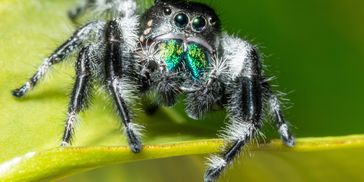
A lot of people are terrified of spiders, textbook arachnophobia. But fear not, because there’s a new kid on the block who’s changing the game one tiny bounce at a time: the Jumping Spider Phidippus regius.
Forget the creepy crawlies lurking in corners. These little powerhouses belong to the Salticidae family, jumping spiders. They don’t
A lot of people are terrified of spiders, textbook arachnophobia. But fear not, because there’s a new kid on the block who’s changing the game one tiny bounce at a time: the Jumping Spider Phidippus regius.
Forget the creepy crawlies lurking in corners. These little powerhouses belong to the Salticidae family, jumping spiders. They don’t bother with webs or drama; they simply rely on fantastic eyesight and Olympic-level hops to snag their dinner. The only thing they ask for in return? A solid 12 hours of bright light a day so they can keep performing their acrobatic stunts.
Despite their heroic confidence, they’re nowhere near tarantula-sized. Males reach up to about 18 mm, females up to 22 mm, small, compact, and perfectly sized for maximum cuteness. Kept in the right conditions, they’ll stick around for 1–2 years, charm included.
Telling the boys from the girls is surprisingly easy once they’ve grown a bit
Males: Dressed in classic black and white with shimmering blue-green chelicerae, think of them as the stylish ones showing off their metallic accessories.
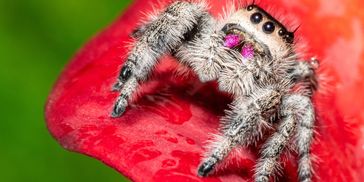
Females: More colourful, often with pinkish chelicerae that they modestly keep tucked behind fluffy white palps, subtle, but iconic.
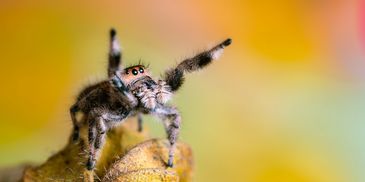
A terrarium. One per spider, please, unless you’re keen on hosting a tiny gladiator arena, which I strongly advise against. Glass or acrylic works perfectly, so long as you’ve got ventilation at both the top and bottom to keep the airflow on track. Aim for a minimum footprint of 15×15×15cm (6”), which gives your Phidippus regius enough r
A terrarium. One per spider, please, unless you’re keen on hosting a tiny gladiator arena, which I strongly advise against. Glass or acrylic works perfectly, so long as you’ve got ventilation at both the top and bottom to keep the airflow on track. Aim for a minimum footprint of 15×15×15cm (6”), which gives your Phidippus regius enough real estate to truly live its best life.
Pro tip: choose an enclosure that opens from the side. These little overachievers love constructing their own penthouse suite (a neat silk cocoon) right at the top. They spend a significant portion of their working day in there, resting, observing, and conducting six to eight critical “growth and development upgrades” (moults) on their journey to adulthood. Opening the lid from above risks collapsing their luxury loft, and nobody wants to be that landlord.
Go easy on the décor. These spiders don’t hunt using webs; they’re more parkour athletes than fishermen. They leap at their prey, deploying a safety line like a high-risk professional who still believes in compliance. Keep clutter minimal to maximise their hunting efficiency and give them the operational space they need to thrive.
These refined little athletes come from the warm, temperate charm of South-Eastern America, think Florida and the Bahamas, so they expect their accommodation to be suitably “holiday ready.” Aim for a temperature of 22–26°C. You can stretch that to 20–28°C if you’re feeling generous, but anything outside that range will earn you a very u
These refined little athletes come from the warm, temperate charm of South-Eastern America, think Florida and the Bahamas, so they expect their accommodation to be suitably “holiday ready.” Aim for a temperature of 22–26°C. You can stretch that to 20–28°C if you’re feeling generous, but anything outside that range will earn you a very unimpressed spider.
If your home already feels like a tropical resort, room temperature is fine. If you live somewhere that makes penguins feel welcome, a small heat mat on the side or back of the enclosure will do the job.
Just remember: heat mats need a thermostat probe inside the enclosure unless you want your spider’s home turning into an accidental sauna.
Humidity? Simple. A light mist on the side of the tank every couple of days, well away from your eight-legged lodger, is all this species needs.
The tank floor should have a decent layer of substrate. If you’re going bioactive (and making your spider’s life feel like a luxury spa), you’ll need a membrane to separate it from the drainage layer. We prefer clay balls. Our substrate mix is a tasteful blend of coconut fibre, peat, and orchid bark. Add a Fittonia or a nice pothos for aesthetics; after all, your spider deserves better than plastic plants that look like they escaped from a 1990s aquarium kit. Seed the substrate with springtails and tropical woodlice, your miniature housekeeping team, specialising in waste removal and mould prevention.
Placement matters, too. Don’t put the enclosure on a sunny windowsill unless you want to cook your spider faster than a forgotten potato in a microwave. Kitchens are also a no-go thanks to fumes, oils, and cleaning chemicals.
And finally, be aware that anything treated with flea products should stay out of the spider room for 48 hours. Spiders are also not fans of deodorants, perfumes, or air fresheners, so think of their space as a no-fragrance corporate zone: clean, controlled, and definitely not drowning in Lynx Africa.
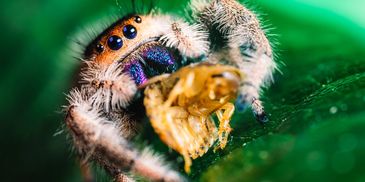
Feeding your regal little acrobat is all about portion control. Tiny slings start on Melanogaster fruit flies or aphids; think of it as their baby-food phase. As they level up, you can graduate them to Hydei fruit flies, eventually moving on to Green bottles and then Blue bottles as they approach their rebellious Subadult era.
Flies are ba
Feeding your regal little acrobat is all about portion control. Tiny slings start on Melanogaster fruit flies or aphids; think of it as their baby-food phase. As they level up, you can graduate them to Hydei fruit flies, eventually moving on to Green bottles and then Blue bottles as they approach their rebellious Subadult era.
Flies are basically the superfood smoothies of the jumping-spider world, top-tier nutrition with zero attitude.
Some folks offer mealworms and crickets, but we don’t roll that way. If you do choose the crunchy crew, make sure the feeder is no more than half the size of your spider. Anything larger can bite back or bring along parasites, and honestly, nobody wants drama at dinner.